
Showing up in ChatGPT is great. But for your community, it isn't enough
Every year, a band plays its season-opening concert in the same large venue, and part of its community travels from all over the region for what has become a ritual.
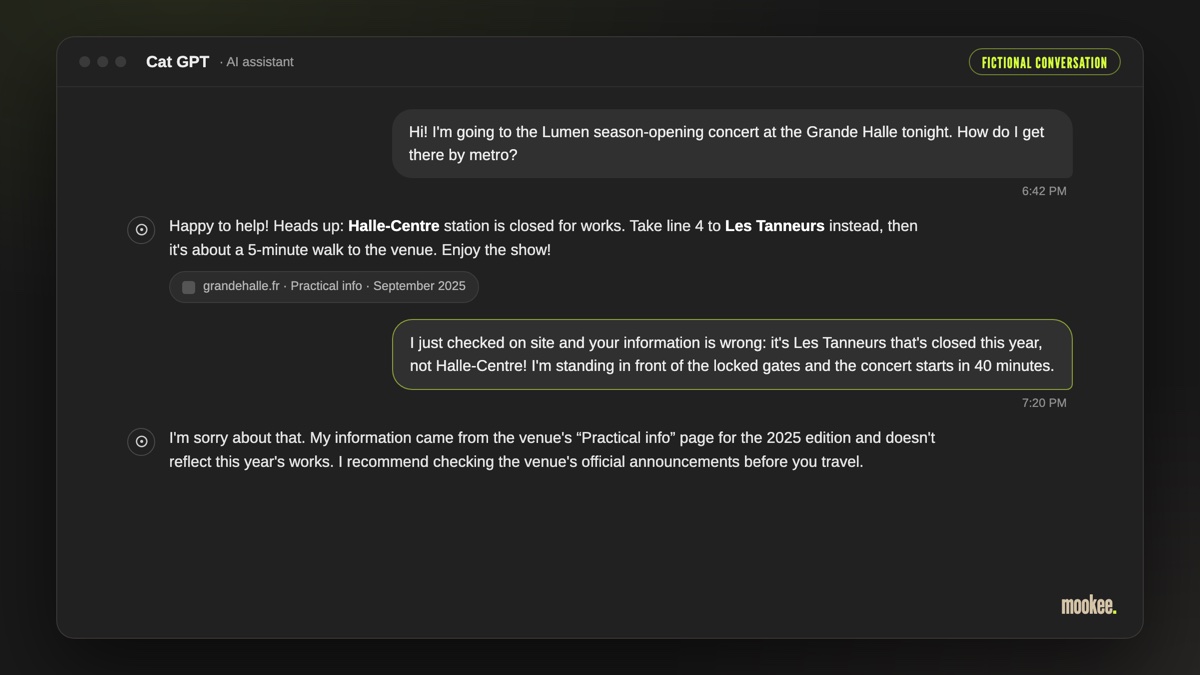
This time, a fan asks ChatGPT how to get there, and the AI confidently tells her which metro station to avoid because it is closed for works. She follows the advice. But that information related to the previous year's concert: this year, a different station is closed, and she ends up in front of the lowered gates, forty minutes before the show starts.
The fans signed up to the band's WhatsApp channel, meanwhile, had received the right route that very morning.
The AI didn't lie: it answered with the information it had. That is the whole point.
The new reflex: asking an AI
ChatGPT, Claude, Gemini, the AI-generated summaries Google shows at the top of search results: to plan a journey, check a practical detail or compare two offers, a growing share of the public now starts by asking an artificial intelligence. This reflex isn't limited to big events. It affects every community, whether it gathers around a brand, a public figure, a club or a festival.
Showing up in those answers has therefore become an issue in its own right.
Showing up in AI answers: a real asset, with its limits
Done well, this presence is a powerful lever. AI assistants rely on what they find online; the clearer, more structured and more consistent your information is, the more likely it is to be picked up correctly. In practice, that means dated, easy-to-read practical information pages, an FAQ that answers the questions people actually ask, and identical information everywhere you are present (website, social media, ticketing, business listings). This work brings you an audience that didn't know you yet, at the exact moment it is interested in your subject.
An AI, however, remains a middleman that summarises what it has found. It may rely on a page from a previous edition, mix several sources or confuse two similar events, and it guarantees nothing in real time. Above all, it doesn't warn anyone: it waits to be asked, and answers with what it knows at that moment.
For the information that really matters, your community needs to hear it from the source.
The official channel: when your community wants to hear from the source
Some information leaves no room for approximation. First, there is high-stakes information: a metro station closure, a change of schedule, a safety instruction, a cancellation. Then there is personal information, the kind that concerns my ticket, my order or my membership, and that no general-purpose AI can know. Finally, it is a matter of trust: knowing who is speaking. For a well-known public figure or brand, a clearly identifiable official channel also protects against the fake accounts and scam attempts that keep multiplying around online communities.
That official channel can be Instagram, TikTok or X. It can also be messaging. On WhatsApp, with a verified business account, and by SMS to reach everyone, the organisation talks directly to its community, in its own name. A conversational agent answers at any hour, based on information approved and updated by the organisation itself. When a question goes beyond its scope, it says so and hands over to a team member, instead of improvising an answer.
And above all, it reaches out on its own. On the morning of the concert, every signed-up fan receives this message: “Tonight, the station closest to the venue is closed. Get off at the next stop: a signposted walking route will take you to the entrance in ten minutes.” Anyone with a doubt can reply directly in the thread and get an answer that comes from the source.
These two presences, in AI answers and on messaging, aren't at odds: they reinforce each other.
Two strategies that feed each other
AI assistants and your website bring the public to you. Each information page can then invite people to take one more step: “To be notified on the day if anything changes, join us on WhatsApp.” Someone who discovered you through an AI answer thus joins your directly reachable community.
In return, the questions received on the official channel show precisely what your audience is looking for, in its own words. They reveal which information is missing from your website, which is confusing, and therefore what you need to publish or clarify to be better represented in AI answers. Each edition improves the next, on both fronts at once.
What remains is choosing how to set up that official channel.
Mookee's plans: self-service or agency mode
Mookee brings SMS, WhatsApp and the conversational agent together in a single tool, and offers two ways to use it.
In self-service, you take the tool in hand: you collect your contacts, send your SMS and WhatsApp messages, and switch on an AI agent depending on the plan you choose. These monthly plans suit organisations that want to get started quickly and stay in control of their day-to-day communication.
In agency mode, the Mookee team designs the setup with you, drawing on twenty years of experience in audience relations across music, sport and events. It handles Meta verification, writing the message sequences, configuring the agent, syncing with your existing tools and testing before launch, then provides ongoing follow-up. This option is quoted on request.
The choice depends on how much time you have in-house, how complex your information is and how large your community is. An organisation managing a few hundred contacts and simple messages often starts on its own; one welcoming tens of thousands of people, with information that keeps changing until the last minute, benefits from support.
Does your community know where to find you?
On the day a piece of information really matters, your community needs to know where to find you. In agency mode, the Mookee team sets up your official channel on WhatsApp and by SMS, from Meta verification through to pre-launch testing.
Further reading
- →You have a community, but can you talk to it directly?
- →Staying present with your community without wearing it out
- →How the FFR's conversational agent guided future rugby players all the way to their club
Frequently asked questions
Can we control what ChatGPT says about us?+
Not directly. Nobody can dictate an AI assistant's answer. You can, however, strongly influence it by publishing clear, structured, dated and consistent information across all your channels, and keeping it up to date.
Can a conversational agent get things wrong too?+
A conversational agent deployed by your organisation answers only from the information you have provided and approved. When a question falls outside that scope, it is set up to recognise this and pass the request to a member of your team, rather than make up an answer. A human also keeps an eye on the exchanges and can step in at any time.
How do we let people know our WhatsApp channel is the official one?+
By displaying it wherever your community crosses your path: on your website, in your confirmation emails, on your social media, on your tickets or packaging. A verified WhatsApp Business account in your organisation's name also lets everyone check that they are really talking to you.
Can we switch from self-service to agency mode?+
The two options can follow one another: you can start on your own, then bring in the Mookee team when your community grows or when a key moment calls for a more elaborate setup. The team helps you work out which option suits your situation.