
Staying present with your community without wearing it out
A community needs looking after. On social media, a brand or artist who stops posting gradually disappears from people's feeds. By email, a newsletter that only goes out once a year ends up in spam, or simply stops being opened. Messaging follows the same rule: to stay on your community's mind, you have to talk to it regularly.
As on every channel, the whole challenge is finding the right pace and frequency. On WhatsApp and SMS, the stakes are even higher than elsewhere, since your message lands in the middle of personal conversations. Well judged, it is anticipated and read; poorly judged, it intrudes and prompts people to unsubscribe. That is what this article is about.
Before talking about pace, you need to see the two pitfalls it sits between.
The two ways to lose a community
The first is silence. A community you no longer write to ends up forgetting why it signed up. When a message finally arrives, it reaches people who no longer remember you very well and who, not recognising the sender, unsubscribe.
The second is excess, and more specifically excessive promotion. When every message asks for something (buy, book, take advantage of an offer), the community quickly realises you only write to sell, and it stops reading.
Many organisations alternate between the two without meaning to: nothing for months, then a burst of messages at a launch or when tickets go on sale. The silence weakened the connection, and the burst finishes wearing it down.
Between these two pitfalls, the connection is kept alive through four habits.
Keeping the connection alive: give a reason, get people talking, pace yourself, target
Give people a reason to open every message
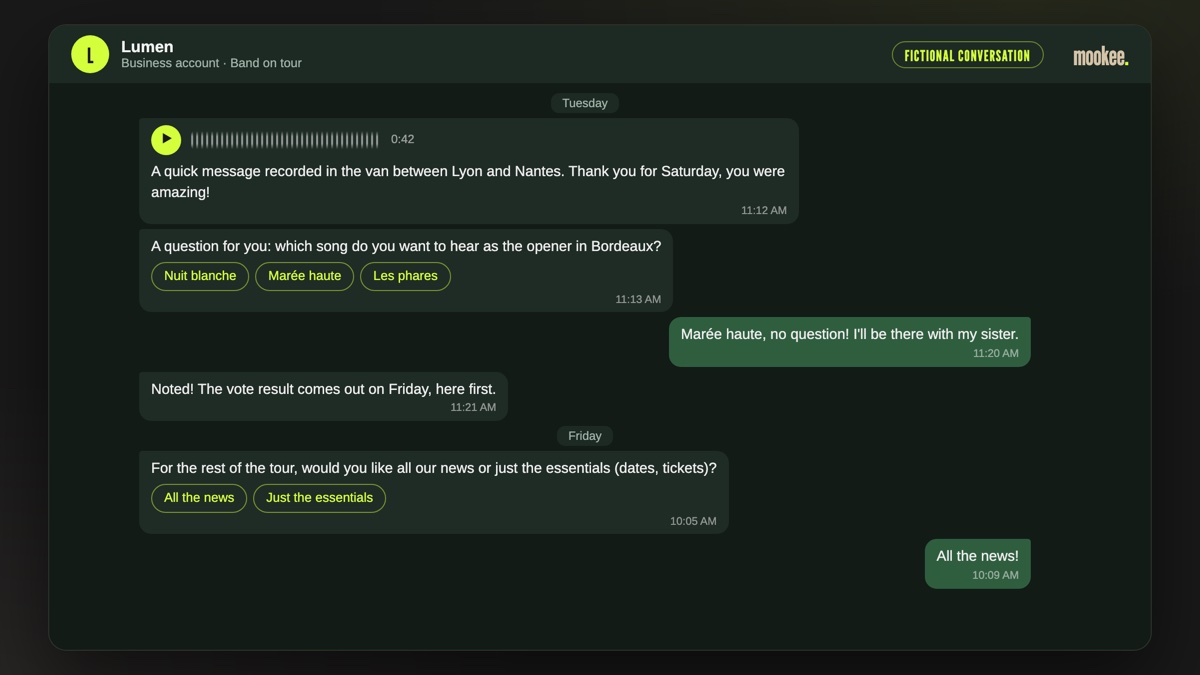
Information already posted on Instagram the day before, or already in the latest newsletter, adds little to a private conversation. The best thing messaging can offer is what exists nowhere else: early access, a behind-the-scenes moment, a personal touch. A cosmetics brand can give its most loyal customers twenty-four hours' notice before a new product launches; an artist can send a voice note recorded between two tour dates; a club can share a photo of the dressing room with its season ticket holders a few minutes before kick-off. Each message then becomes a small privilege that people come to look forward to.
Get people talking rather than broadcasting
That privilege gains even more value when it opens an exchange. Messaging is the channel where a community replies as naturally as you write to it, and it would be a shame not to give it the chance: “Which song do you want to hear as the opener at the next concert?”, “Red or green for next season's shirt?”, “Have you tried it? Tell us what you think.” A community that replies keeps the connection alive by itself, and teaches you what it likes along the way. The conversational agent makes sure no reply goes unanswered: it says thank you, answers the questions that come up and passes on to the team whatever deserves its attention.
Find the right pace
Then there is the question of how often to write. There is no universal frequency: a brand that launches one collection per season, a club that plays every week and an artist in the middle of a tour have neither the same key moments nor the same expectations. Good practice is to alternate busy periods, when messages come closer together (a launch, a tour, the end of a season), with quiet periods, when an occasional message is enough to stay in touch. Often the simplest approach is to let members choose between receiving all the news or only the important announcements. The signals do the rest: plenty of replies mean the pace is right, while a rise in unsubscribes after a send is a cue to slow down or change your tone.
Send each person what concerns them
The last habit alone avoids a large share of unnecessary messages: don't send everyone the same thing. Someone who has just bought doesn't need the next day's promotion, and a fan who lives at the other end of the country has no use for a local date. By segmenting your community according to what you know about it (purchases, replies, city, preferences), each person receives fewer messages, but messages that concern them. (See: Segmenting your audience to talk to it better)
In short, to stay present without wearing people out:
- every message brings something you can't find elsewhere;
- every message invites a reply, as far as possible;
- the pace follows your key moments and each person's preferences;
- everyone receives the messages that concern them.
Pacing, targeting, making people want to read without wearing them out: this know-how can't be improvised. It is built message after message, in contact with communities, and that is exactly what the Mookee team has been doing for twenty years.
Mookee: twenty years of keeping the connection alive with audiences
For twenty years, the Mookee team has been writing to communities of fans, supporters and customers on behalf of concert venues, festivals, clubs and brands. It knows which messages people look forward to, when a reminder becomes one too many, and how to adapt the pace to a music, sports or brand community.
This know-how is available in two ways. In self-service, you schedule your SMS and WhatsApp sends, segment your community and switch on a conversational agent to answer those who write to you. In agency mode, the Mookee team designs the editorial calendar with you, writes the messages, configures the agent and adjusts the pace as replies come in, so your community stays attentive from one key moment to the next.
Keep a community that wants to read you
On the day you have something important to announce, your community still needs to want to read you. In agency mode, the Mookee team builds the editorial calendar with you, writes the messages and adjusts the pace as replies come in.
Further reading
- →You have a community, but can you talk to it directly?
- →Showing up in ChatGPT is great. But for your community, it isn't enough
- →Audience segmentation: how to make your WhatsApp and SMS campaigns more effective
Frequently asked questions
How often should you message your community?+
There is no universal rule: the right frequency depends on your activity and on what you have to say. The best guide is the usefulness of each message, because an occasional but anticipated message keeps the connection alive better than a string of sends nobody reads. Replies and unsubscribes quickly tell you whether the pace is right.
WhatsApp or SMS for regular messages?+
The two complement each other. WhatsApp lends itself to regular, rich messages (photos, videos, voice notes, questions with reply buttons), while SMS suits short, important announcements and reaches people who don't use WhatsApp. Mookee lets you combine both depending on the type of message and each person's preferences.
What should you do if unsubscribes go up?+
First, look at which messages triggered them: a send that was too promotional, a message off-topic for part of the community, or a series of sends too close together. Depending on the case, it may be enough to space out messages, target recipients better or put exclusive content back at the heart of your sends. Offering to receive fewer messages, rather than unsubscribing entirely, also helps you keep some of those people.
How do you reconnect with a community you haven't contacted in months?+
By not opening with a request. The first message should remind people who you are, explain why you are getting back in touch and offer something (news, an exclusive, a thoughtful gesture) without asking for anything in return. It can also invite everyone to confirm they want to keep receiving your messages, which cleans up your list and lets you start again on a clear footing.