
You have a community, but can you talk to it directly?
A London skatewear brand has 40,000 followers on Instagram. One Tuesday, it launches a limited-edition capsule collection: a polished post, several stories, a countdown. By the following evening, some of the pieces are still in stock, and under the post a loyal customer leaves a comment: “Why didn't I know about this?”
The brand does have a loyal, engaged community. It simply can't reach it directly.
A community you can reach directly, or one you can't
A community gathered on a social network is very real: people who follow your posts, comment, share and sometimes buy. But you can only reach them through the platform, and the platform sets the rules. The algorithm decides who sees your message and when; a change in how it works can cut your reach overnight; an account can be restricted or suspended; and your follower list doesn't belong to you.
A community you can reach directly rests on a simple principle: you hold its members' contact details, and you can reach them whenever you decide, with no middleman. This applies to a brand as much as to a public figure, a sports club, a festival or a non-profit. Social media remains valuable for getting noticed and attracting new people; the whole point is to move some of those followers into a community you can reach yourself.
Most organisations already have the first direct channel: email.
Email: a valuable list, rarely used for conversation
Email has a major advantage: the contact list is yours. Nobody decides for you who will receive your messages, and that list follows you whatever sending tool you use.
In theory, nothing stops you from having conversations there. In practice, email serves two main purposes: one-way promotion, with the newsletter sent to the whole list, and practical information, with order confirmations, appointment reminders or customer service replies. Either way, nobody is working on the conversation: you send, you hope for an open, a click, rarely a reply.
To turn that direct link into a real conversation, one channel stands out.
SMS and WhatsApp: the conversation channel par excellence
Messaging is where your community already talks, to family, to friends, to group chats. A message sent by SMS or WhatsApp lands in the same place as theirs, in an app opened dozens of times a day. It gets read and, above all, people reply to it naturally, as they would to any other message.
The two channels complement each other. WhatsApp carries rich exchanges: videos, voice notes, photos, quick-reply buttons. SMS reaches everyone, with no app to install. Combined, they are today the most effective way to talk directly to a community, and to be listened to.
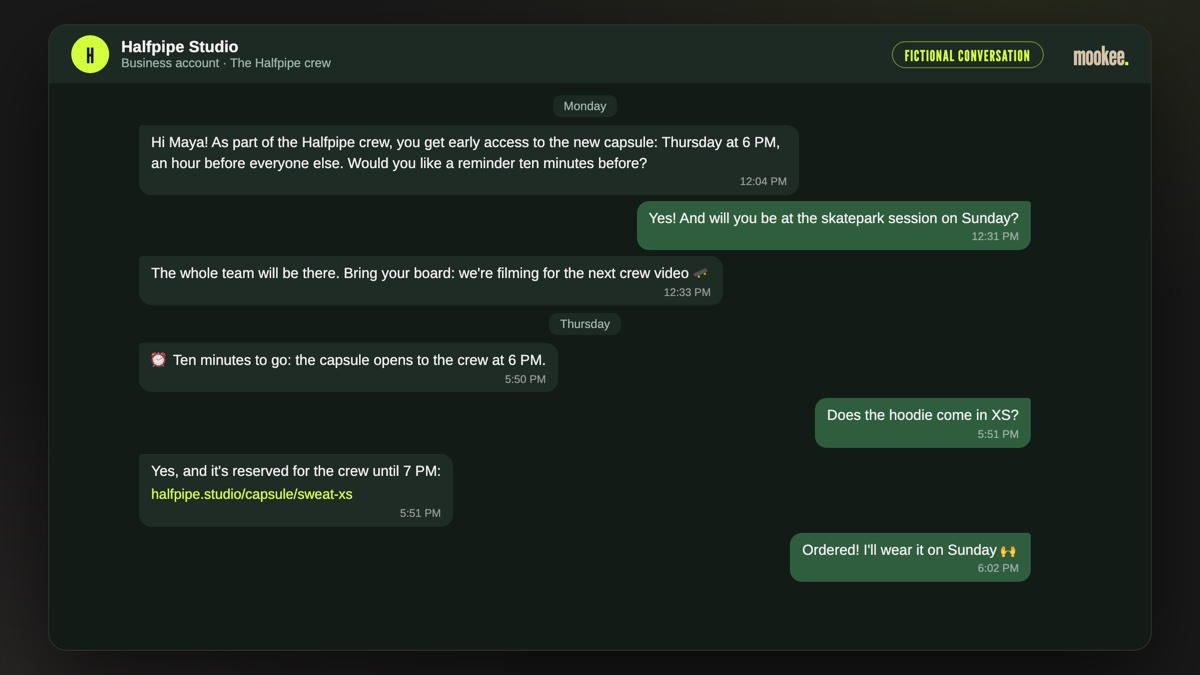
Back to the skate brand. For its next collection, it sends a WhatsApp message a few days before launch: “The capsule drops Thursday at 6pm, in limited quantities. Want a reminder ten minutes before?” The customer replies “Yes!”, gets her reminder on Thursday at 5:50pm, then asks a question: “Does the hoodie come in XS?” The answer arrives within a minute, with a direct link to the size she asked for.
Give a community a voice and it will use it. To keep up at scale, you need backup.
Keeping the conversation going at scale: the conversational agent
When several thousand people can write to you, answering each one by hand quickly becomes impossible. A conversational agent then takes over: it answers at any hour, on behalf of the brand or public figure, in their tone and based on their approved information. It points people to the right product, the right page or the right person.
It doesn't replace humans, though. Someone keeps an eye on the exchanges, receives the sensitive cases the agent passes on, and steps in whenever a situation calls for it. That way, the team can focus on the exchanges that truly deserve its attention.
Along the way, every conversation teaches you something about your community.
What conversation teaches you
Where a social media post boils down to numbers (views, likes, shares), a conversation brings answers. You know who asked for a reminder, who is looking for a particular size, who is hesitating because of the price, who comes back for every launch. This information, expressed in your community's own words, belongs to you just as much as the contact list does.
It then lets you talk to each person about what interests them: announce that a size is back to those who were waiting for it, give your most loyal members early notice, avoid sending a promotion to someone who has just bought. (See: Segmenting your audience to talk to it better)
What remains is building that community you can reach directly.
Where to start: collect numbers wherever your community crosses your path
Your community already crosses your path in many places, and each of them can become an opportunity to collect a number, with explicit consent.
The channels you already own come first: sign-up on your website, in-store or online purchases, newsletter subscriptions, ticketing, contact forms. Each time, a dedicated box lets the person choose to receive your messages by SMS or on WhatsApp. Meeting points round out the setup: a link in your Instagram bio, a QR code on a label, on packaging or at a stand during an event, which opens the conversation directly.
Those contacts still need to be kept in one place rather than scattered. Syncing automatically feeds the numbers collected across your different tools (website, online shop, CRM, email marketing tool) into a single list, with no manual export. Every new sign-up thus joins your directly reachable community, whatever its entry point.
Finally, joining has to be worth it: early access to launches, exclusive content, information you can't find anywhere else. Once the community is in place, the pace of sending matters as much as the content: frequent enough to keep the connection alive, measured enough not to wear people out. (See: Staying present with your community without wearing it out)
How you get started then depends on the size of your organisation and the time you can devote to it.
Mookee: self-service or agency mode
Mookee brings SMS, WhatsApp and the conversational agent together in a single tool. The self-service plans let you start on your own: collect your first contacts, send your first messages, switch on an agent to answer common questions.
For organisations that want support, agency mode draws on twenty years of experience in audience relations across music, sport and events. The Mookee team designs the conversational agent and message sequences with you, sets up the syncs with your existing tools, then configures and tests everything before launch. You stay in control of tone and content, and Mookee handles the rest.
Could you talk to your community tomorrow morning?
If you had to talk to your community tomorrow morning, without going through an algorithm, could you? In agency mode, the Mookee team sets up the direct channel, the conversational agent and the syncs with your tools alongside you.
Further reading
- →Staying present with your community without wearing it out
- →Showing up in ChatGPT is great. But for your community, it isn't enough
- →Audience segmentation: how to make your WhatsApp and SMS campaigns more effective
Frequently asked questions
Should you give up on social media?+
No. Social media is still the best way to get noticed and attract new people. Messaging takes over to keep in touch with those who want to go further, and every post can invite people to join the conversation.
How is this different from a newsletter?+
A newsletter sends the same content to an entire list and waits for a click, whereas messaging opens an exchange: each message can prompt a reply, and each reply shapes what comes next. The two work together, with email remaining ideal for long-form content and practical information.
How do you respect consent and the GDPR?+
Each person must explicitly choose to receive your messages, either by ticking a dedicated box or by starting the conversation themselves through a link or a QR code. They must also be able to unsubscribe easily at any time. Mookee has these consent and unsubscribe mechanisms built in.
Which tools does Mookee sync with?+
Mookee connects to the main tools used to manage a community: website, online shop, CRM, email marketing tool, ticketing. The exact connections depend on your setup, and the Mookee team checks them with you before launch.